
Before Your 24-Inch DTF Line Arrives: The Electrical, Exhaust and Site-Readiness Checklist Indian Print Shops Need
A DTF printer's electrical label is only one part of its production line. Use this practical India-specific checklist to prepare power, extraction, floor access and sample sign-off for a printer and automated powder dryer.
A print-shop owner may spend weeks comparing printheads, film width and six-pass speed, then discover that the powder dryer needs a much more substantial electrical and ventilation plan than the printer itself. By the time a heavy machine reaches the building, the wrong door width, unfinished exhaust route or overloaded power board can turn installation day into a costly delay.
For an Indian garment decorator buying a roll-fed DTF printer with an automatic shaker and curing dryer, site readiness should be agreed before dispatch, not improvised after the crates arrive. Here is a practical way to plan the complete line, using one documented HJD configuration as an example without assuming that every 24-inch machine has the same specifications.
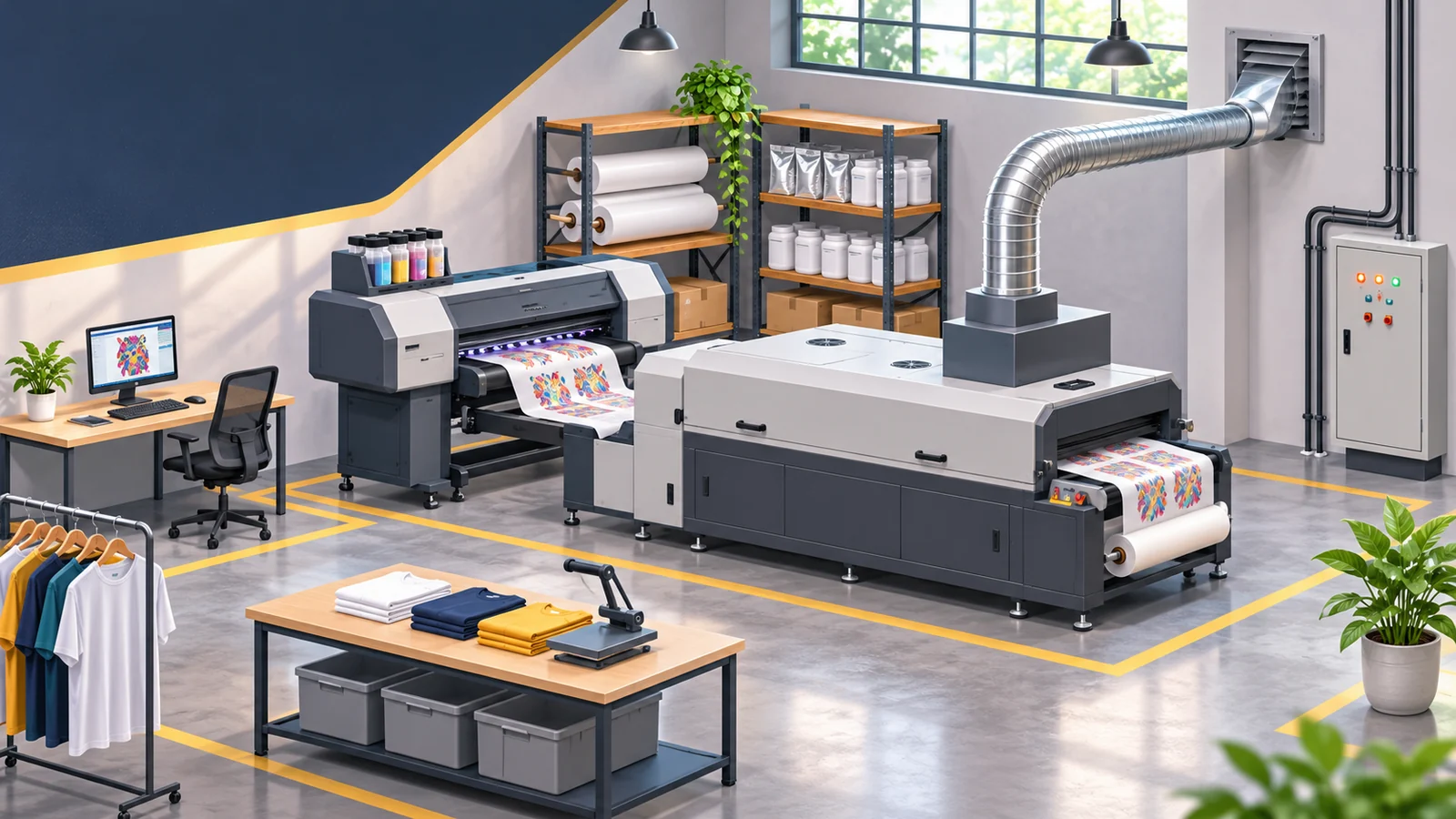
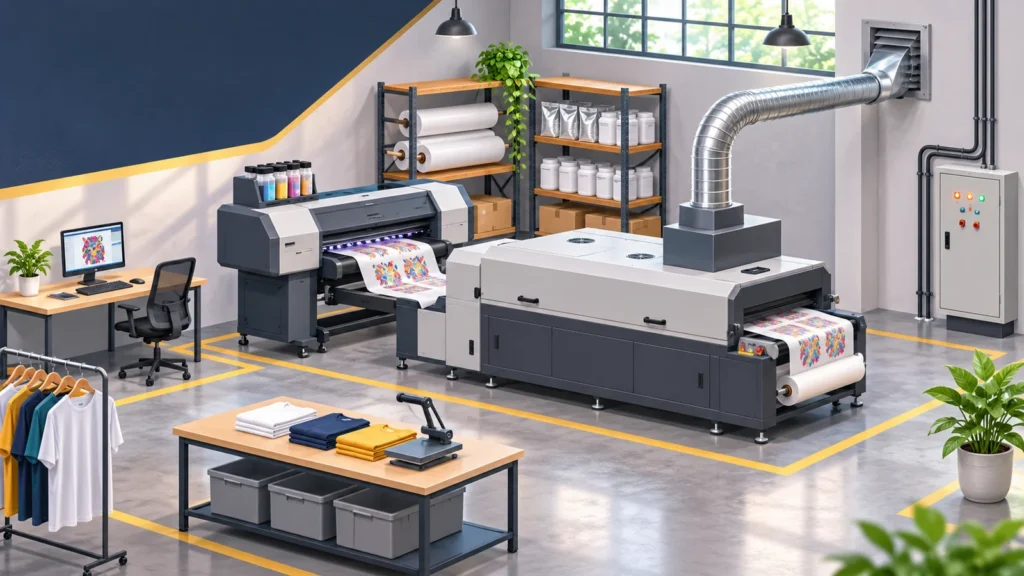
Conceptual featured illustration, not a photo of an HJD machine, a certified installation or an existing customer site.
First, separate the printer from the dryer
A "DTF machine" on a sales quotation can describe several different pieces of equipment. The printer applies CMYK and white ink to PET film. A shaker distributes the correct hot-melt powder, removes surplus powder and conveys the film through a curing section. A heat press then applies the prepared transfer to fabric, often elsewhere in the room.
The HJD four-printhead DTF printer with advanced powder shaker provides a helpful concrete example. Its public catalogue currently lists 1,000 W printer power, a separate 7,000 W dryer, 220 V/50 Hz/33 A for the dryer, and a 65 cm maximum print width. The product page also lists a 20–28 °C working-temperature range and separate printer and dryer weights. These are brochure-derived figures for the listed configuration, not site measurements or a promise that the exact unit quoted will match them.
The basic equipment subtotal in that example is:
1.0 kW listed printer + 7.0 kW listed dryer = 8.0 kW of listed equipment power.
That number excludes the heat press, local exhaust equipment, workstation, HVAC and other electrical consumers. It is not an instruction to fit an 8 kW circuit, a prediction of kWh consumption, or a breaker/current design. Duty cycles, startup behaviour, power factor, actual nameplates, cable runs, protective devices and local supply conditions all matter. Obtain a written load schedule and have the final design reviewed by a qualified electrician in line with applicable Indian safety requirements.
Make an electrical-load schedule before the advance becomes a dispatch date
Write down the power requirement for every item supplied and every item you plan to add later. The printer and dryer should be separate lines on that schedule. A heat press is also a distinct heating load; for instance, ProlificGeeks lists an HJD-K601 40 × 60 cm heat press as another machine family, but its supply and protective requirements must be checked for the exact quoted version rather than assumed from its platen size.
A useful load schedule records each machine’s model and serial/nameplate at delivery, supply voltage, phase and frequency, listed and measured electrical demand where appropriate, planned isolation/protection, earthing verification and commissioning sign-off. Identify which devices might operate simultaneously. Ask the site electrician whether the existing distribution board, building feeder and utility connection can support the installation, including permissible backup arrangements and heat load.
Do not substitute a domestic extension board, an improvised socket or a generic stabilizer recommendation for a designed supply. ProlificGeeks’ warranty policy also identifies power issues and environmental damage among important exclusions. The 2023 Central Electricity Authority safety regulations are a regulatory reference for competent electrical design—not a one-size-fits-all wiring diagram for this machine.
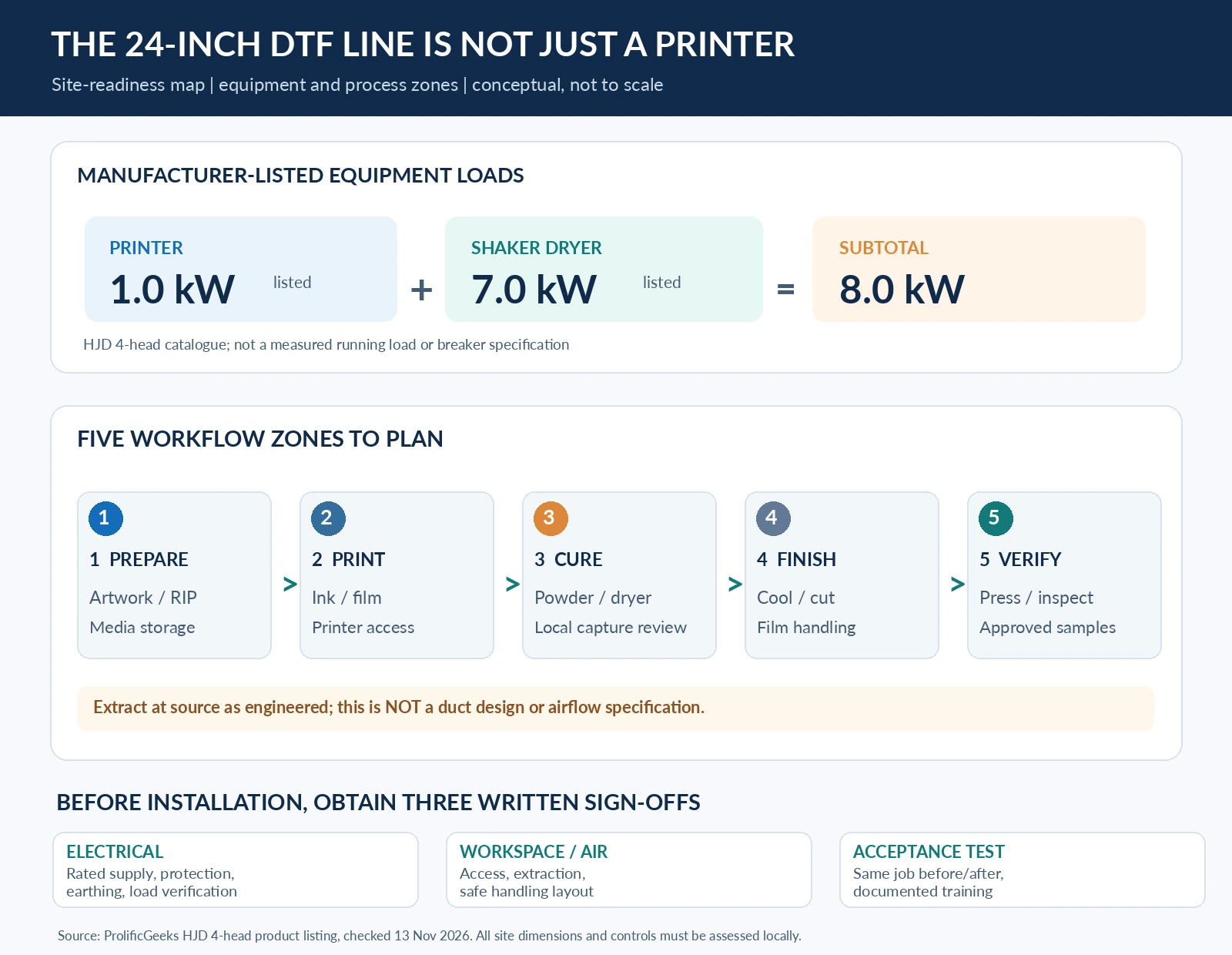
Original source-traceable infographic. The 8 kW subtotal uses the current HJD catalogue values, not an onsite test. Process zones are conceptual and not to scale.
Plan powder handling and exhaust as a process, not an afterthought
Loose hot-melt adhesive powder can become airborne during loading, shaker operation, maintenance and cleanup. Heating adhesives and inks can also create fumes or odours, with the relevant risks depending on the exact substances and operating conditions. Request a safety data sheet for your actual powder and ink, rather than borrowing another brand’s SDS and treating it as equivalent.
For example, a DTF consumables supplier’s public powder-handling warning cautions against inhaling loose powder or fumes and describes skin/eye irritation precautions for its particular product. This illustrates why actual material documentation matters; it does not certify the chemistry or safe exposure limits of any material purchased through ProlificGeeks. Obtain the actual powder’s current SDS separately.
A competent ventilation specialist should assess enclosure, source capture near the powder and curing stages, extraction routing, makeup air, filter selection and safe discharge. General NIOSH engineering-control guidance explains the advantage of capturing dust near its source; that material is from a different industrial process and must not be used as a DTF airflow specification or Indian legal limit. A window fan is not a documented substitute for a designed capture system.
Keep powder handling away from food, clean finished garments and uncontrolled foot traffic. Establish safe cleanup, storage and filter-maintenance procedures according to the actual SDS and supplier instructions. Never infer that the presence of an exhaust duct in a brochure photo means the site will automatically meet health or environmental requirements.
Walk the delivery route with a measuring tape
Room length is only the start. Measure the narrowest doorway, stair landing, lift opening and turning radius from the unloading point to the machine location. Assess floor levelness, structural load limits, lifting and handling requirements, and how an engineer will reach both sides of the machine after installation.
The specific HJD four-head catalogue lists 175 kg printer net weight and 300 kg dryer net weight, with larger packed weights. They are two separate equipment masses; don’t turn their sum into an assumed single floor-point load. Confirm actual crate dimensions, lifting points, centre of gravity and clearance requirements with the supplier and a competent site professional.
A practical layout separates artwork/RIP preparation, film/ink storage, printing, powder and curing, film cooling/cutting, and final heat-press/inspection. The room must allow safe operator movement, service access, consumable storage, waste handling and a clear fire/exit route. No dimension in the infographic above is a certified clearance.
Commission the same sample you will actually sell
Do not accept the installation based only on the printer powering on or producing a generic demonstration sheet. Before the engineer arrives, choose a representative customer-style job, the intended film and garment, and specific acceptance criteria agreed in writing.
Three stages of a useful acceptance record
Before delivery: confirm the ordered machine configuration, included powder/dryer unit, electrical plan, ventilation arrangement, moving route, RIP/computer requirements, starter consumables, warranty terms and engineer travel obligations. Photograph site readiness and ask the supplier to acknowledge outstanding items.
During commissioning: identify the actual installed heads and nameplates, record software versions and settings, inspect the nozzle pattern, verify film feed and powder distribution according to manufacturer guidance, and check visible curing behaviour using the correct materials. The electrical and extraction professionals should sign off their own work; a printing engineer should not be assumed to certify unrelated building systems.
After a representative job: print a small sample set, heat-apply it to the intended fabric using verified transfer instructions, inspect appearance and adhesion by an agreed method, record rejects and compare the output with your written acceptance criteria. Keep the raw production log, not simply a video of one successful transfer. For general acceptance-test principles, SGS India describes testing against agreed specifications rather than unspecified expectations.
A useful handover folder contains signed machine and installer details, actual photos, warranty/serial records, the completed training roster, an approved RIP recipe, the consumable batch information, service contacts and unresolved punch-list items. Any performance claim must be based on a measured, documented trial; catalogue speed is not a guarantee of saleable transfers per hour.
Budget for the hidden supporting equipment
Two quotations with the same printer price may lead to different installed budgets. Compare them only after including electrical work, exhaust/filtration, any air-conditioning or environmental controls, delivery and unloading, heat-press equipment, workstation/RIP, starter consumables, operator training, and expected maintenance supplies. Reserve space for ongoing film and powder storage, not just the first day of operation.
ProlificGeeks’ printing machine buying guide can help with the general shortlist; the DTF machinery catalogue shows separate printer and powder-handling categories. These pages are starting points, not substitutes for a written configuration-specific site plan.
Frequently asked questions
Is a normal household 15 A socket enough for an industrial DTF dryer?
Do not assume so. The cited HJD four-head configuration lists a dryer at 220 V/33 A, which is already a reason to request professional electrical design. Actual circuit and protective-device selection must come from verified nameplates, manufacturer instructions and a competent electrician—not an article or a salesperson’s guess.
Can I run a DTF powder shaker without an exhaust system?
Do not make that decision from equipment photos. Have the actual powder/ink SDS, curing conditions, room layout and ventilation professionally assessed. Confirm the manufacturer and local requirements in writing.
Does a 24-inch printer guarantee a particular number of shirts per hour?
No. Nominal film width, pass mode, artwork layout, curing, cutting, heat pressing, operator handling and rejected pieces all affect accepted production. Ask for a test based on your jobs and consumables.
Does included installation mean electrical work and exhaust construction are included?
Not necessarily. Confirm every scope item in writing. The product listing describes installation/training eligibility for certain machine purchases while separately identifying engineer travel/accommodation responsibilities. Building wiring, ducts and room modifications must never be silently assumed to be included.
Ask for a written site-readiness review before your machine ships
Start with the exact HJD four-head DTF printer and powder-shaker listing if it fits your shortlist, then send ProlificGeeks your city, floor plan, access measurements, electrical supply description, daily job mix and sample artwork. Use the site-readiness enquiry on the contact page to request configuration-specific confirmation. Existing machine owners can use the support centre for setup or technical questions.
The most useful installation-day outcome is not a machine that merely switches on. It is a documented production line that the site, operator and supplier can understand, test and maintain.
Editorial technical references: public HJD catalogue specifications; the Central Electricity Authority’s 2023 safety regulations; a separate powder supplier’s public handling warning; NIOSH general source-capture principles; and SGS India’s description of factory acceptance testing. These sources do not establish a completed installation, regulatory certification or measured output for any ProlificGeeks machine.